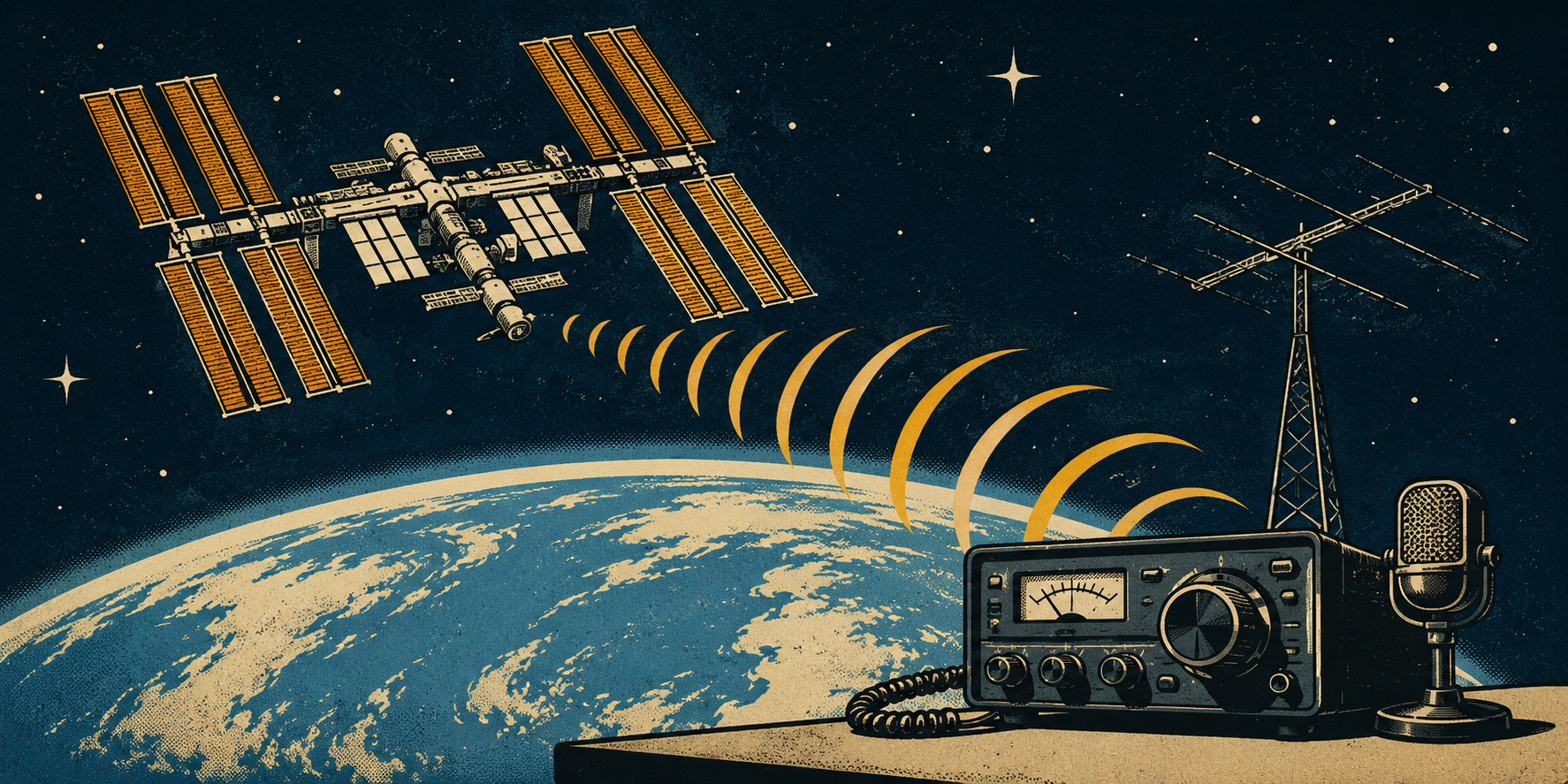
For over 25 years, amateur radio equipment has been operating aboard the International Space Station (ISS) as part of the ARISS program (Amateur Radio on the International Space Station). Thanks to this system, radio amateurs around the world can receive signals from the station, use its repeater, send APRS packets, and with a little luck—even talk directly with an astronaut.
Two Kenwood TM-D710GA transceivers are currently operating on the ISS, specially adapted for space conditions. They provide FM voice communications, satellite cross-band repeater operation, digital APRS digipeater functionality, and SSTV image transmissions, making the ISS one of the most interesting and accessible amateur radio satellites.
Several specially designed ARISS antennas are installed on the exterior of the station. The Russian Zvezda module contains four antennas—three multi-band antennas supporting the 2-meter band (144 MHz), 70 cm band (435 MHz), as well as the L and S bands. There is also a fourth antenna with a vertical radiator approximately 2.5 meters (8 feet) long, designed for 10-meter HF operation; however, it is currently not in use. The European Columbus module has additional antennas supporting the Kenwood radio system and the HamTV amateur digital television system.
Interestingly, the L- and S-band antennas were designed and built by Wrocław University of Science and Technology in Poland, commissioned by ARISS-Europe and supported by the European Space Agency (ESA). This represents one of the most significant Polish contributions to the development of amateur radio communications aboard the ISS.
One of the most popular ISS functions is APRS operation on 145.825 MHz. The ISS acts as a digipeater—it receives packets from ground stations and retransmits them, allowing operators to send their position reports or short messages thousands of miles away during a single pass over Europe.
Can you talk with an astronaut? Yes, although it requires some luck. Astronauts sometimes conduct unscheduled radio contacts during their free time, most often in the evenings or on weekends. Listening should be done on 145.800 MHz FM. Since an ISS pass usually lasts only 5–10 minutes, it is important to check the exact time when it will appear above the horizon. In addition to occasional contacts with amateur radio operators, scheduled ARISS educational contacts are regularly organized with schools around the world.
Although Polish radio amateurs did not build the main amateur radio equipment installed on the ISS, they have actively participated in the ARISS program for many years—organizing school contacts with astronauts and regularly using the repeater and APRS digipeater. It is also worth mentioning Polish astronaut Sławosz Uznański-Wiśniewski, who is a licensed amateur radio operator and conducted educational ARISS contacts with students during his mission, inspiring the next generation of radio and space enthusiasts.
The adventure of space amateur radio is easier than it may seem—you do not need a large base station or expensive directional antennas. For your first ISS reception attempt, all you need is a simple handheld VHF/UHF radio (Baofeng, Yaesu, Icom, Kenwood) and a basic antenna. Many amateur radio operators started exactly this way, using a handheld radio with the standard “rubber duck” antenna and receiving signals from a space station flying hundreds of miles above Earth.
Better results can be achieved with a higher-gain antenna. For working through the ISS repeater, a popular choice is a 5/8-wave vertical antenna for the 2-meter band mounted high above ground, or a directional Yagi antenna manually aimed toward the passing spacecraft. Because the ISS moves very quickly across the sky, a directional antenna sometimes requires continuous tracking of its position, but it greatly improves the chances of making a successful contact. Many operators also use portable Yagi antennas mounted on small tripods or handheld during passes.
The first step is to check when the ISS will be visible from your location. Applications such as Heavens-Above or ISS Detector work very well for this purpose. The best passes are those where the station reaches a high elevation above the horizon—ideally above 40 degrees. During these passes, the signal is stronger and the ISS remains within range for several minutes.
During a pass, it is best to first monitor 145.800 MHz FM, where you may hear astronauts or other stations using the repeater. For APRS, tune to 145.825 MHz and configure your radio with the proper packet settings and ARISS path. Under favorable conditions, you may see your station or transmitted message appear in online APRS databases.
For a radio amateur located near Chicago, the ISS is a particularly interesting target—the region regularly experiences favorable passes. With good visibility, you can not only receive signals from the station but also make contacts with other radio amateurs across the continent. There is a unique feeling when a signal from a small handheld radio is not bouncing off a local repeater tower, but instead is being relayed through antennas mounted on a space station flying more than 250 miles above Earth.
(ISS talking to kids at school in Indiana: https://youtu.be/Ou9lO_sw3Ww)