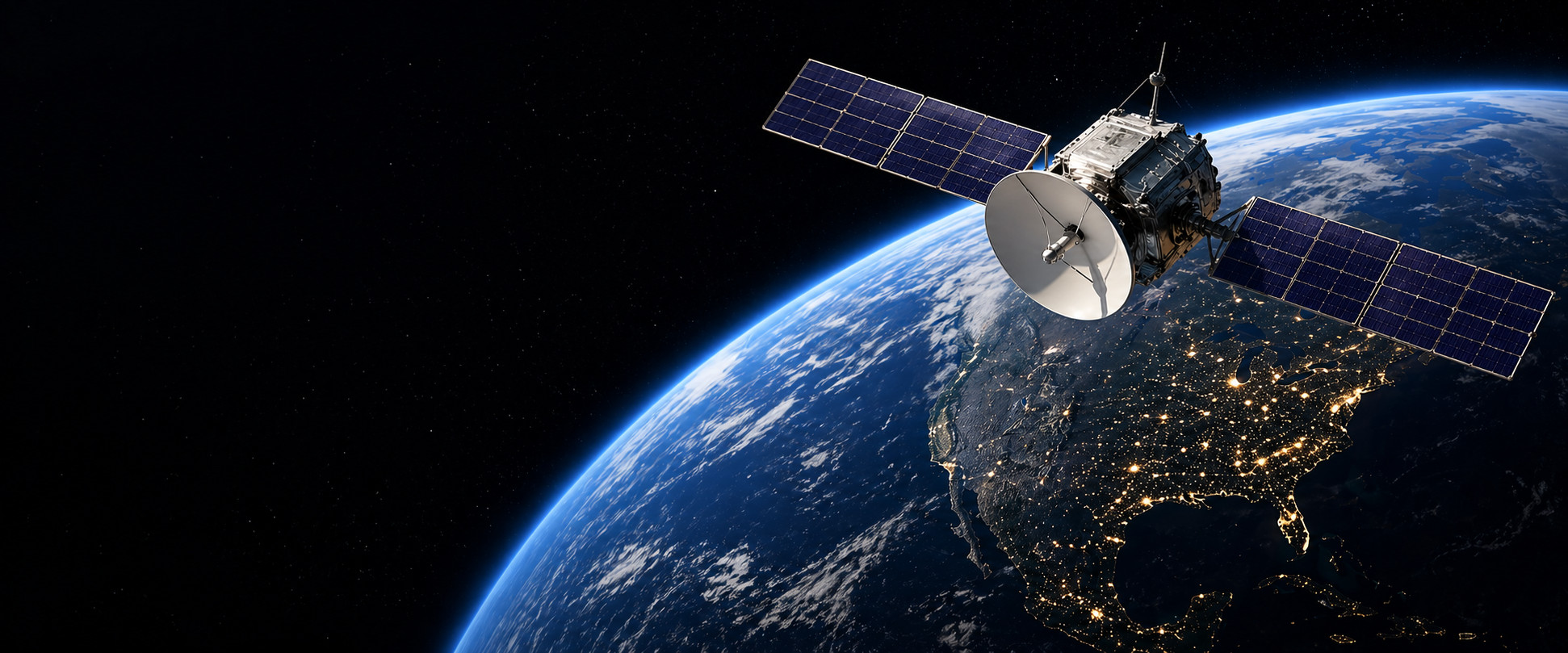
The amateur radio community is once again buzzing about the idea of a geostationary satellite for hams. During this year’s HamCation 2026 and discussions led by AMSAT-DL, the “futureGEO” project returned to the spotlight — a successor to the concept first demonstrated by the QO-100 satellite. Since the launch of Es'hail-2 / QO-100 in 2018, amateur radio operators across Europe, Africa, and parts of Asia gained something that once seemed almost impossible: continuous access to a geostationary amateur radio transponder.
Unlike traditional LEO satellites, which pass over an operator for only a few minutes at a time, a geostationary satellite remains fixed in the same point in the sky. This allows for stable voice communications, digital modes, DATV, microwave experimentation, and even the creation of permanent communication networks.
QO-100 proved to be both a technical and social success. Thousands of operators built their own satellite stations, often using inexpensive offset dishes, LNB converters, and small microwave amplifiers.
While QO-100 covers Europe, Africa, and parts of Asia, North and South America remain outside the satellite’s footprint. For years, amateur radio operators in the United States, Canada, and Latin America have hoped for a similar project dedicated to the Western Hemisphere.
That is exactly the purpose behind the “futureGEO” concept. The project envisions either launching a new geostationary satellite or placing an amateur radio transponder aboard an existing commercial satellite platform, similar to the approach used with QO-100.
During HamCation 2026, the topic resurfaced in presentations and discussions within the satellite community. Representatives from AMSAT and AMSAT-DL discussed potential cooperation with satellite operators and commercial partners.
Although no official timeline or funding has yet been announced, the renewed discussion alone has generated significant excitement among amateur radio operators. Many believe that the success of QO-100 demonstrated the real value of such systems for education, technical experimentation, and emergency communications.
The biggest obstacle, of course, remains cost. Launching a geostationary satellite — or even securing space on a commercial platform — is an enormous financial and organizational undertaking.
Another major challenge involves frequency coordination and international spectrum management. The microwave bands used by amateur satellites are becoming increasingly crowded with commercial operators.
Even so, the AMSAT community emphasizes that interest in amateur satellite communications continues to grow, and the success of QO-100 proved that even highly ambitious projects can become reality.
For many radio amateurs, the futureGEO project symbolizes the future of ham radio itself — combining the classic spirit of radio experimentation with modern space technology.
If the project moves forward, operators throughout the Americas could, for the first time, gain permanent access to their own geostationary satellite, opening entirely new possibilities for experimentation and everyday communication.
One thing is certain — geostationary amateur satellites are no longer just a dream. Thanks to the success of QO-100, the amateur radio community now knows these projects are truly possible.