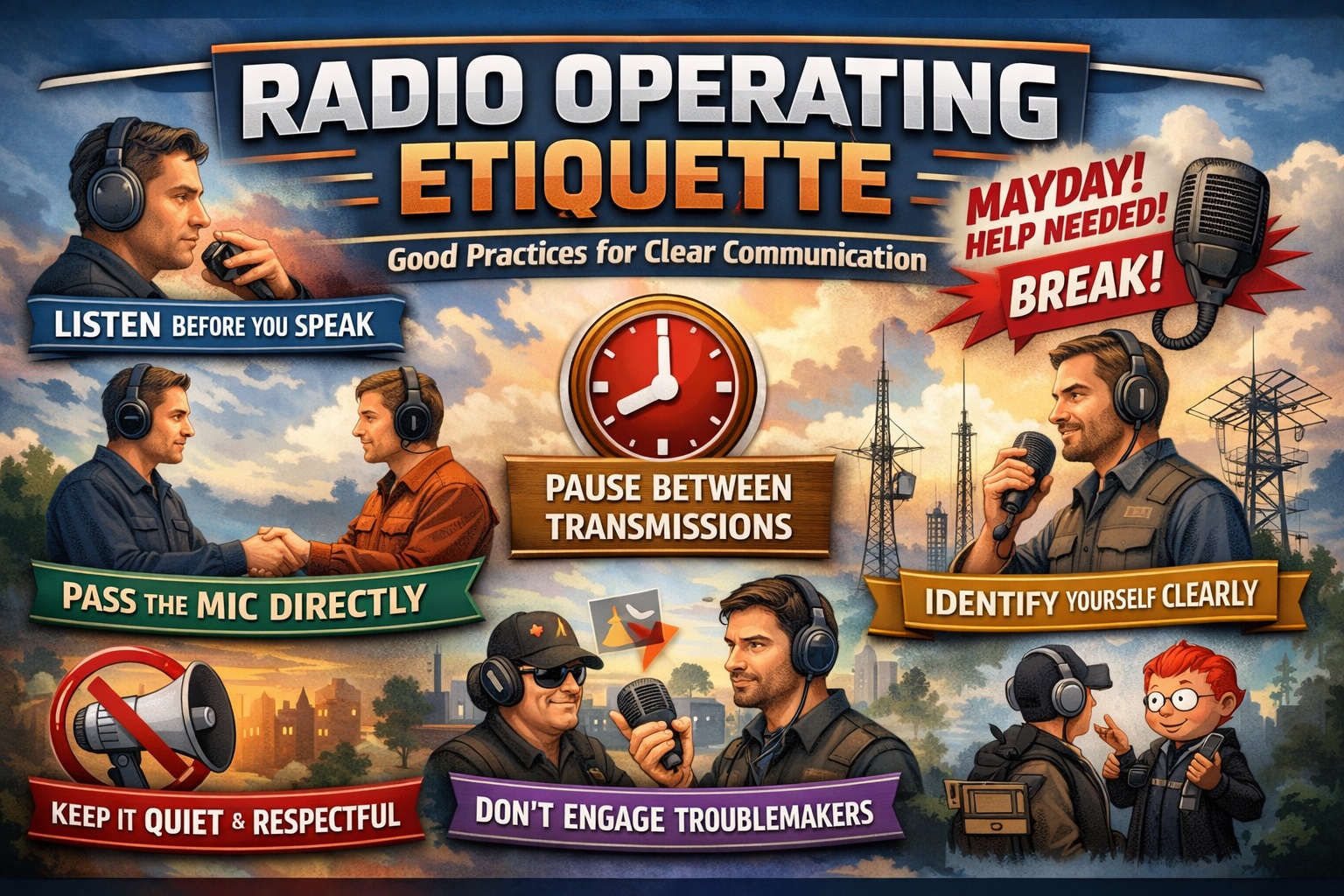
Amateur radio is not just about technology and regulations — above all, it is a community of operators who share a common radio space. Operating on repeaters and talkgroups requires attention to certain rules that make coexistence on the air easier for everyone. While many of these principles also apply on HF, here we focus on communications on the VHF/UHF bands, where following them contributes to smooth and efficient conversations.
Before joining an ongoing conversation on a repeater or talkgroup, take a moment to listen. Pay attention to the topic being discussed, the order in which operators are speaking, and the overall character of the QSO. Only once you understand the situation should you give your call sign during a pause between transmissions to signal your desire to join. Patiently wait until you are heard and invited into the conversation. If it doesn’t work the first time, don’t give up — try again. This approach shows respect for those already engaged in the QSO and helps prevent chaos on the air.
There is one crucial exception to the above rule. If you need immediate help or have information about a life-threatening situation, do not wait even a second. Between transmissions, call out loudly: “MAYDAY, MAYDAY!”, “HELP NEEDED!”, or “BREAK, BREAK!” — anything that will immediately capture the attention of other operators on the repeater. Once you gain access to the frequency, give your call sign and briefly but clearly describe the situation. Then yield the microphone to one of the stations coordinating the traffic to prevent communication chaos. In emergencies, every second counts, and safety procedures always take precedence over etiquette.
When operating on a talkgroup or on a repeater with many active stations, always pass the microphone to a specific station — never let it hang or pass it “to the group in general.” This practice eliminates the risk of two or more stations transmitting at the same time, known as a “double.” It ensures everyone knows who is supposed to transmit next, keeping the conversation smooth and orderly. If you pass the microphone to a station and it does not respond, the microphone automatically returns to you as the station that managed the handoff. Do not break in at this point — allow the controlling station to pass the microphone again or continue the conversation.
Good operating practice also calls for brief pauses between transmissions. This allows new stations to join a repeater conversation without interrupting an ongoing QSO. It also gives linked systems — such as links, bridges, and reflectors — time to properly disconnect and switch. Additionally, it allows other operators to respond in urgent or emergency situations. A two-second pause between transmissions is a small price to pay for everyone’s comfort and for the reliable operation of radio infrastructure.
When transmitting, give the call sign of the station you are calling or passing the microphone to first, and your own call sign last. In the USA, identification is required by regulations at least every 10 minutes; in Poland, every 5 minutes, as well as at the beginning and end of each contact. However, it is recommended to identify on every transmission on a repeater — this is good practice and makes it easier to follow the conversation. An important note regarding the language of identification: identify in the language of the country from which you are physically transmitting, or in English if you are a guest in another country. If you are transmitting from Poland to a talkgroup which repeater is located in the USA, you should still identify in Polish, because you are physically transmitting within Polish radio spectrum and are subject to Polish regulations.
Calling a specific station reserves time for you on the repeater or talkgroup. Remember, however, to “release” the frequency if your attempt to establish contact is unsuccessful. Another station may be waiting to call you but does not want to interrupt your attempt. An example of proper procedure: “SQ9NKU, this is W9GIL” — after a few seconds of pause and no response — “Nothing heard, W9GIL clear.” This lets other operators know they are free to join the conversation or make their own calls.
If you feel a sneeze or cough coming on, release the PTT first, and only then let the natural reflex happen. It is unpleasant for listeners — and their speakers, and sometimes even their neighbors — when someone coughs, sneezes, or clears their throat with the microphone keyed. This is a simple gesture of respect that shows awareness of the other operators on the far end of the repeater. After all, radio is about communication, not transmitting every sound from your station. Such small consideration makes conversations more enjoyable for everyone on the talkgroup.
If someone appears on a talkgroup, frequency, or repeater and deliberately interferes with communications, ignore them completely. Do not engage in arguments, disputes, or attempts to “educate” the intruder. Such actions only encourage further provocation and give them exactly what they are looking for — attention. If the interference persists and becomes a nuisance, appropriate measures will be taken to resolve the issue. Your role is simply to continue the normal conversation as if nothing were happening.
Etiquette in amateur radio on repeaters and talkgroups is not a set of rigid rules, but a collection of guidelines developed by generations of radio amateurs. Their purpose is to ensure that the shared radio space serves everyone equally and brings enjoyment from communication. Following these principles will not only make it easier for you to make contacts and earn respect within the community, but above all will help keep amateur radio what it should be — a place for friendly exchange of ideas, experience, and a shared passion for radio technology.
73, 806, and catch you on the air!